The Forgotten Database: Why Dive Centers Chase Strangers While Their Best Customers Drift Away
Your divers trusted you with their life
Think about the first time a student breathes underwater with your team.
They are nervous. They are in a world they have never seen. They put their trust in an instructor they met a few days earlier. Then they come back up with the biggest smile of their week.
No coffee chain, hotel or car dealer starts a customer relationship like that. Know, like, trust: a dive center gets all three before the first logbook entry is signed.
And yet, in more than 30 years in this industry, I have seen the same pattern again and again. The course ends. The certification card arrives. The conversation stops. The next season, the dive center spends its marketing budget chasing strangers on social media, while the people who already love it quietly stop diving.
You are a silent seller, and you don't know it. This article is about the most valuable asset your dive center owns, and why most centers never touch it: the database.
The bucket leaks while we pour in new divers
The numbers on diver dropout are old, and that is part of the problem. Our industry barely measures it.
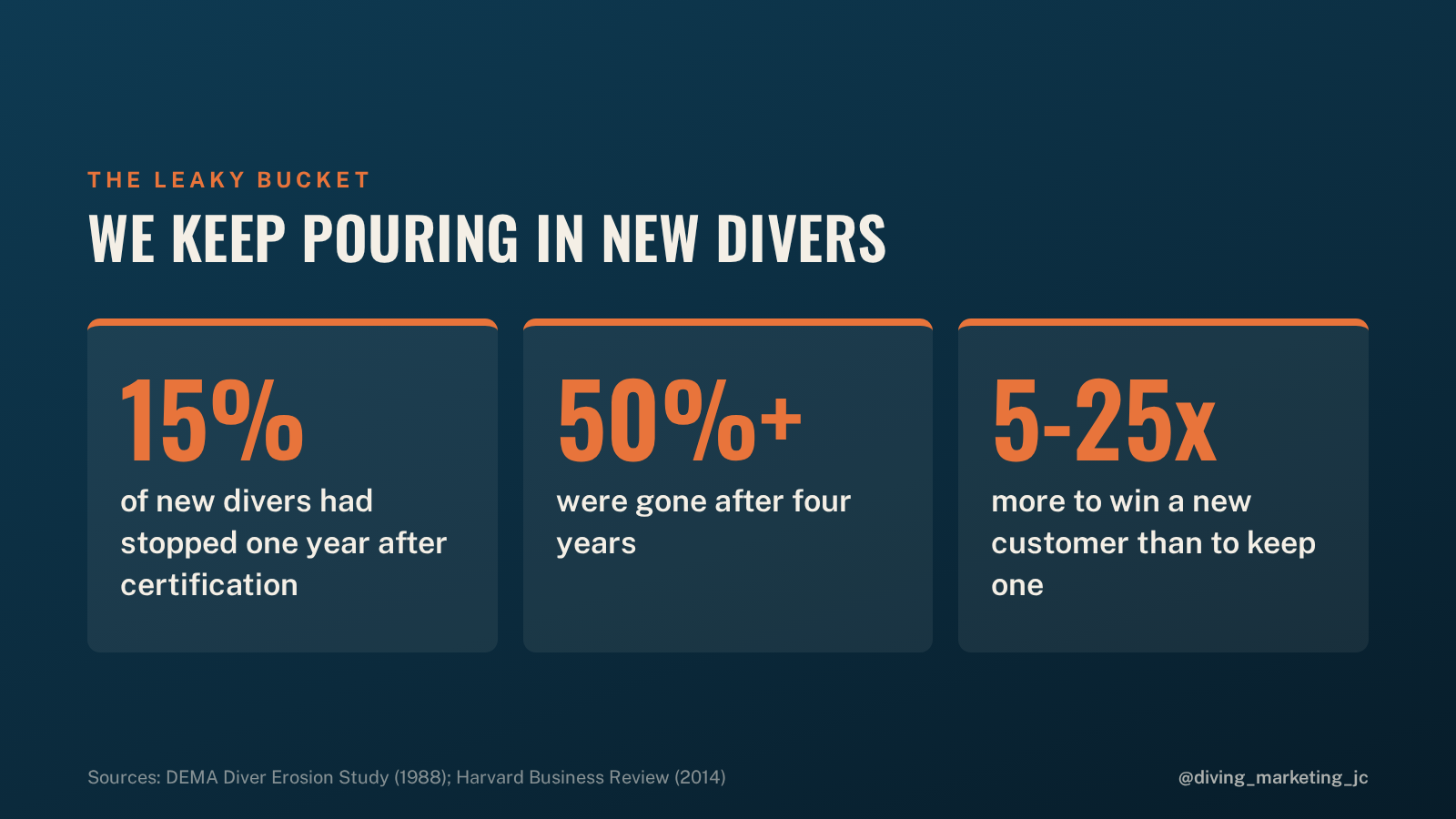
The best-known study, DEMA's Diver Erosion Study from 1988, found that 15% of newly certified divers had dropped out one year after entry-level certification. After four years, more than half were gone. The Business of Diving Institute estimates that if the industry simply halved its dropout rate, it would grow by about 60%.
Look at the United States today. More than 100,000 new divers are certified every year. Yet only about 2.5 million people went diving in the last 12 months, according to DEMA's 2024 Diving Fast Facts. We keep pouring water into a bucket with a hole in it.
Every other industry learned long ago what this costs. According to Harvard Business Review, winning a new customer costs 5 to 25 times more than keeping an existing one. Research by Bain & Company found that a 5% increase in customer retention lifts profits by 25% to 95%.
For a dive center, the math is simple. One certified diver who comes back each year for a fun dive, a specialty course and a regulator service is worth more than an expensive ad campaign aimed at strangers.
What your database already knows
Most dive center owners tell me they don't have a database. They do. It is spread across the booking system, the SSI records, the shop till and a few old spreadsheets. Inside it are four things about every diver:
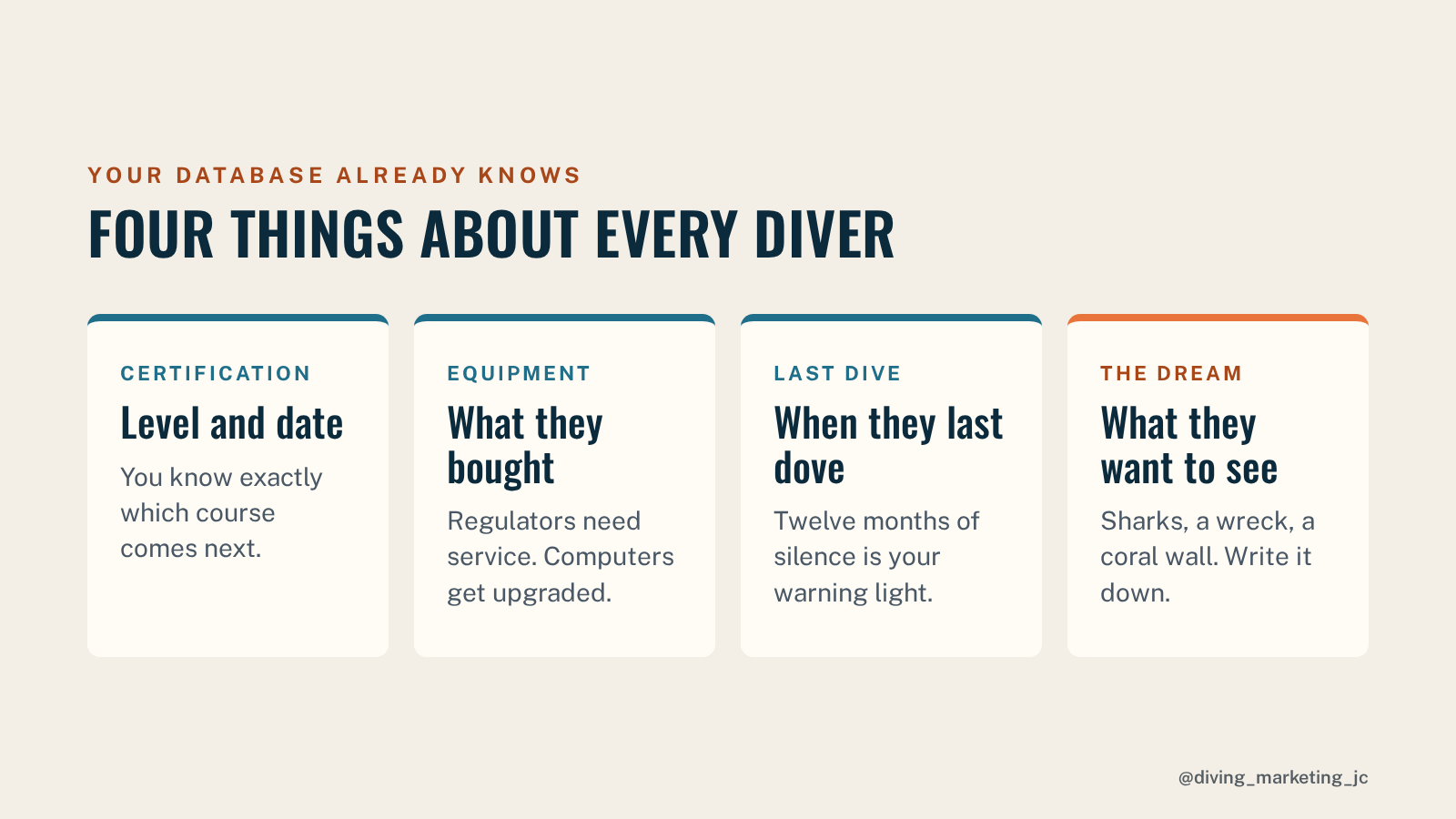
Their certification. Level and date. You know exactly which course comes next.
Their equipment. What they bought and when. Regulators need servicing and computers get upgraded.
Their last dive. Twelve months of silence is your warning light.
Their dream. Sharks, a wreck, a coral wall. They told you on the boat. Almost nobody writes it down.
DEMA's own consumer data shows why this relationship matters so much. When divers choose where to buy equipment, they rate knowledgeable staff at 4.3 out of 5, equipment service at 4.0, and staff they know and trust at 3.9. Warranties and try-before-you-buy score lower. Divers buy from people, not prices. No online shop can compete with that, but only if you stay in their life.
The same data shows how long a diver's journey lasts. The average Open Water diver is about 30. Continuing education divers average 35, equipment buyers 43, and travel diver households are led by someone around 54. That is more than twenty years of courses, gear, service and trips. The question is who they spend it with.
Five industries that keep customers with far less
Here is what I find remarkable. Industries with a much weaker first experience than ours keep their customers far better. They simply decided that the second visit matters more than the first, and built a system around it.
Industry | They start with | What they built | Result |
|---|---|---|---|
Coffee (Starbucks) | A drink and a few minutes | A rewards app where every visit counts toward the next | 34.6 million active US members (Q1 fiscal 2025) |
Hotels (Marriott) | A bed for one night | Bonvoy: points, status and member-only experiences | 271 million members; 68% of room nights booked by members |
Dentists | An appointment nobody wants | Recall: the next visit is booked before the patient leaves | Without it, the average dentist keeps only 4 in 10 patients (JADA) |
Motorcycles (Harley-Davidson) | A machine in a garage | H.O.G., local owners' chapters run through dealers since 1983 | 1 million+ members who spend about 30% more |
Ski resorts (Vail) | A lift ticket | The Epic Pass, sold before the season starts | Passholders were more than 70% of visits in 2023-24 |
Each one translates directly to a dive center:
The dentist: book the next dive or course before students leave the boat.
Starbucks: a dive log card where every 10 dives earns a free guided dive or a specialty discount.
Marriott: member-only moments, like the first seat on the wreck trip or the night dive.
Harley-Davidson: a dive club run by your center, with monthly meet-ups and one group trip a year.
Vail: an annual dive pass, sold to your own divers during the off-season, so the cash is in the bank before the first boat leaves.
None of these need new software to start. A spreadsheet and a calendar reminder are enough for the first month. Pick one, not five.
Start with the dream, then wake up your database in 30 days
The most valuable field in your database is not the email address. It is the dream.
Ask every diver one question: 'If you could dive anywhere, what would you want to see?' Write the answer next to their name. That one field turns a list of emails into a list of people.
Then help them reach it. The course that prepares them, like Deep, Wreck or Nitrox, is your revenue. The trip, booked through a partner such as liveaboard.com, and travel insurance such as DiveAssure are added value and affiliate income. You taught them to breathe underwater. Be the one who takes them to see what they always dreamed of.
The off-season is the perfect time to start. Here is a simple 30-day plan:
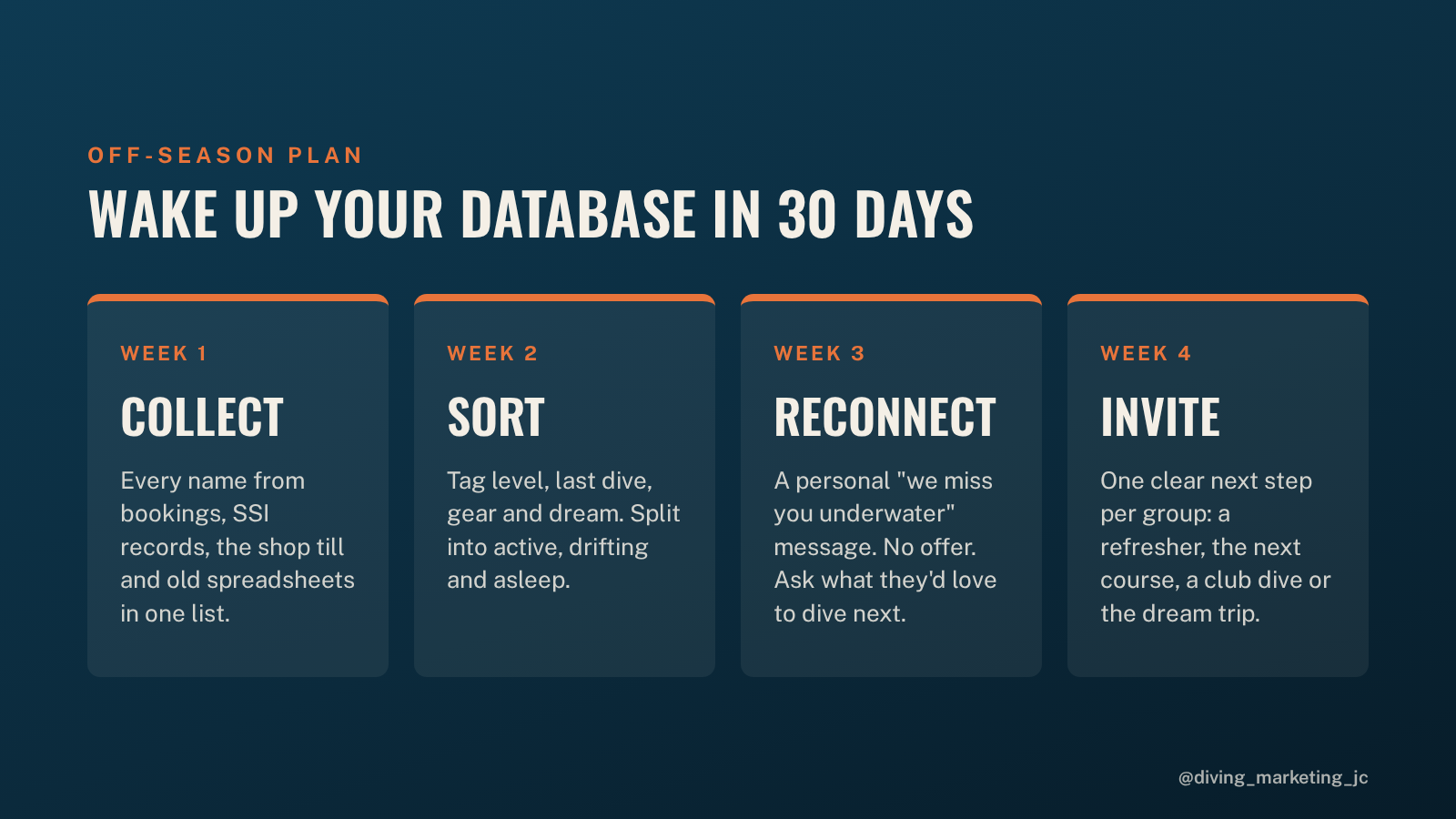
Week 1, collect. Pull every name from bookings, SSI records, the shop till and old spreadsheets into one list.
Week 2, sort. Tag each diver by level, last dive, gear bought and dream. Split them into three groups: active, drifting and asleep.
Week 3, reconnect. Send a personal 'we miss you underwater' message. No offer yet. Just ask what they would love to dive next.
Week 4, invite. Give each group one clear next step: a refresher, the next course, a club dive or the dream trip.
The divers who reply in week 3 tell you exactly what to offer them in week 4.
Three numbers to track every month
Stop measuring likes. Measure whether the relationship survived the certification card:
Return rate: the share of last year's divers who booked anything with you this year.
Next step booked: the share of students who leave a course with their next dive or course already in the calendar.
Revenue per diver per year: courses, dives, gear, service and trips, divided by active divers.
If you only track one, make it the return rate.
You don't need more divers. You need the ones you already have to come back.
Want to see where your dive center is losing divers today? Get my free Business Leak Finder.
A database remembers your divers. But there is one thing that keeps them diving for good, and gyms, Peloton and Harley-Davidson all figured it out. That's the subject of my next article: The Dive Club Effect.
Sources
DEMA, 2024 Diving Fast Facts
Business of Diving Institute, Scuba Divers Dropout Rate
Harvard Business Review, The Value of Keeping the Right Customers
Starbucks Q1 Fiscal 2025 results
Hotel Dive, Marriott adds more than 40 million loyalty members
eAssist, Hygiene Recall and Recare by the Numbers
Harley Owners Group, Wikipedia
Ski Area Management, Understanding Vail Resorts' Epic Pass/Day Ticket Equation
